
ArtiCell: Calming the Inflammatory Cycle Behind Skin Ageing
Skin inflammation is a natural immune response that helps protect and repair damaged tissue.
Inflammation is not the enemy in itself. When it is quick and acute, it is a protective response that helps the skin fight pathogens, heal wounds and clear harmful triggers. The problem begins when this response fails to switch off, often because the trigger persists or the skin barrier is compromised. This chronic, low-grade inflammation is the kind that harms the skin. It runs quietly in the background, unseen and unfelt, a slow burn that researchers call inflammaging.
Countering it does not mean suppressing every immune response. The goal is to support the skin’s own ability to adapt to stress and maintain long-term balance.
Why inflammation ages skin
Chronic low-grade inflammation breaks down the skin's structural framework while also reducing its ability to calm immune signals and repair damage. This low-grade micro-inflammation accelerates skin ageing, and as the skin ages, the inflammatory cycle becomes harder to break.
This chronic inflammatory tone keeps several destructive processes running in the background, and their visible effects accumulate over time:
• Collagen breakdown. Inflammatory signalling drives fibroblasts and keratinocytes to produce enzymes such as MMP-1, which cut collagen fibres. At the same time, it suppresses new collagen synthesis. Matrix is lost faster than it is rebuilt.
• Oxidative amplification. Activated immune and skin cells generate reactive oxygen species (ROS). ROS in turn activate production of more inflammatory mediators - a self-feeding loop between oxidation and inflammation.
• Uneven pigmentation. Inflammatory mediators stimulate melanocytes, contributing to blotchiness and post-inflammatory marks, ageing spots.
• A weaker barrier. Cytokines, key inflammatory signaling molecules, down-regulate key barrier proteins and lipid synthesis, so the skin loses water more easily and lets more irritants in.
• Microvascular changes. Persistent vascular inflammation contributes to redness, sensitivity and visible capillaries.
None of these effects is dramatic on any given day but summed over years, they are a large part of what we read as an dull, saggy, face.
Where the inflammation comes from
Inflammaging has several sources, and they reinforce one another. Some come from outside; some are built into ageing itself.
1. Environmental exposure (the exposome). UV radiation is the main culprit: UVB damages DNA directly, UVA generates ROS deep in the dermis, and both trigger cytokine release (IL-1α, IL-6, TNF-α) and MMP induction within hours. Air pollution, particulate matter and blue/visible light add further oxidative pressure. Each exposure is a small inflammatory "hit"; the skin is rarely given time to fully resolve one before the next arrives.
2. Cellular senescence- ageing feeding on itself. As cells accumulate DNA damage, telomere shortening or oxidative stress, some enter senescence: a permanent growth arrest. Senescent cells do not simply sit quietly. They adopt a senescence-associated secretory phenotype (SASP), releasing IL-6, IL-8, IL-1, MMPs and other factors into their surroundings. The number of senescent fibroblasts in the dermis rises with age. Their secretions degrade matrix, disturb neighbouring cells and can push healthy cells towards senescence too. This makes senescence both a consequence of inflammation and oxidative stress and a cause of further inflammation- one of the clearest examples of a vicious cycle in skin biology. On top of this, ageing mitochondria leak more ROS and inadvertently drive further pro-inflammatory signalling.
3. Immunosenescence. The ageing immune system becomes less precise: it clears damaged and senescent cells less efficiently while maintaining a higher baseline of inflammatory signalling. Less clean-up plus more background noise equals more inflammation.
4. Glycation. Sugars and reactive dicarbonyls modify long-lived proteins like collagen, forming advanced glycation end-products (AGEs). AGEs stiffen the matrix and bind the receptor RAGE on skin cells, which activates NF-κB and ROS production, another route by which time itself converts into inflammation.
5. A compromised barrier and microbiome. A weaker barrier lets in irritants and microbes, and shifts in the skin microbiome can tip local immune signalling towards inflammation. This leads directly into the next topic: dryness.
Dryness and inflammation: a two-way street
Dry skin and inflamed skin are often treated as separate concerns. Biologically they are tightly linked, and each can start the other.
From dryness to inflammation ("outside-in"). When the stratum corneum loses lipids or water, transepidermal water loss rises and the barrier becomes permeable. Keratinocytes sense this disruption and respond by releasing pre-stored inflammatory signals. These signals are useful in the short term because they kick-start barrier repair, but when the barrier stays compromised, the alarm does not switch off. A permeable barrier also lets in more irritants, allergens and microbes, each adding its own inflammatory input.
From inflammation to dryness ("inside-out"). Inflammatory cytokines reduce the expression of filaggrin and other structural proteins, disturb ceramide synthesis and lipid organisation, and lower levels of natural moisturising factor. The result is a barrier that holds water less well. Inflammation literally makes skin drier.
Why it matters more with age. Older skin produces fewer barrier lipids, renews its stratum corneum more slowly and recovers from barrier damage more slowly. Combined with a higher inflammatory baseline, this makes the dryness-inflammation loop easier to enter and harder to leave.
The practical consequence is that hydration and inflammation are best addressed together. Humectants, emollients and barrier lipids supply what the skin is missing right now; calming the underlying inflammatory and oxidative stress helps the barrier stay resilient so it can hold on to that hydration.
Why plant cell cultures?
Plants cannot move away from sun, drought, cold or pathogens. Instead, they handle stress chemically: they synthesise antioxidants, UV-screening phenolics and signalling molecules that help their own cells limit oxidative damage and restore balance.
Plant cell culture lets us harness this chemistry in a controlled way. Artemisia vulgaris cells are grown in bioreactors under optimised conditions to efficiently produce compounds that help counter inflammation and support the skin barrier.
In the optimised culture used to manufacture ArtiCell, the plant cells retain their capacity to produce defensive metabolites, yielding a complex mixture rather than a single isolated molecule.
That last point is central to how we think about ArtiCell. Inflammaging is not one pathway, so a single-target ingredient is unlikely to address it well. A complex blend of related metabolites, each with somewhat different targets, is a better match for a multi-step problem.
What is inside ArtiCell
Phytochemical characterisation of ArtiCell shows that the ingredient is dominated by phenolic metabolites, with caffeoylquinic acids as the most prominent and best-defined active fraction, supported by flavonoids and lignans.
Two features of this profile matter for skin. First, the CQAs and flavonoids act on both sides of the oxidation–inflammation loop: they neutralise ROS directly and also influence the signalling that turns oxidative stress into inflammation. Second, the other compound classes, each with a different structure, reach different targets, reflecting the stress-adaptive chemistry of the living plant cell.
Because inflammaging is a loop, blocking it at a single point is easily bypassed by the other routes. ArtiCell's metabolite families map onto several stages at once.
ArtiCell’s plant compounds act at several points along the same chain of events. They help soften the impact of stressors like UV light, neutralise the free radicals that this stress generates, and may encourage skin cells to strengthen their own built-in antioxidant defences. By calming the “alarm switch” that turns this damage into inflammation, they can reduce the signals that break down collagen, weaken the skin barrier and accelerate cellular ageing.
Compound | Key bioactivities |
Pinoresinol glucoside | Strong antioxidant · Anti-inflammatory activity · Barrier support |
Dicaffeoylquinic acids | Strong antioxidant · Protects collagen from UV induced degradation · Anti-glycation activity |
Chlorogenic acid | Antioxidant · Anti-inflammatory · Collagen protection |
Apigenin | Anti-inflammatory · Soothing · Collagen protecting |
Luteolin | Anti-inflammatory · Anti-glycation · Collagen protection |
Where ArtiCell fits for dry, mature skin
ArtiCell is not a classic moisturiser. Its metabolites do not bind water the way glycerin, hyaluronic acid or urea do. Instead, they offer complementary activity: supporting the skin's defences and helping to keep inflammatory signalling in check, so the barrier is under less pressure and better able to maintain itself.
In practice, we see ArtiCell working best as part of a multifunctional team of actives. Think of hydration and barrier ingredients as fixing the leaks, and ArtiCell as helping reduce the pressure that keeps causing them. The shared goal is barrier resilience: the ability to withstand and recover from everyday stress.
From lab to shelf: ArtiCell in MÁDARA’s SOS Hydra line
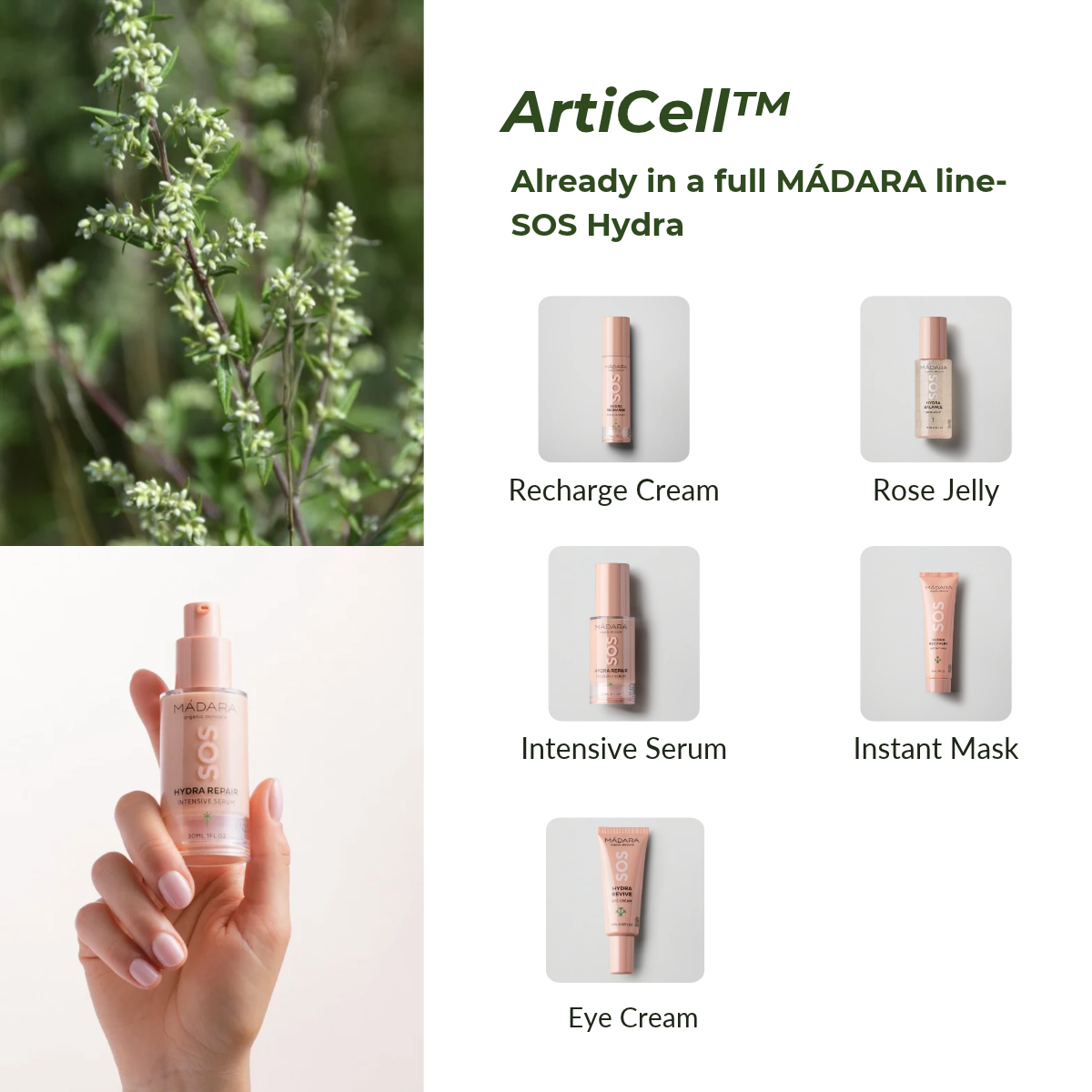
This multifunctional approach is already at work in finished products. When MÁDARA reformulated its well-loved SOS line for dry and dehydrated skin, it added three actives to the formulas: squalane, panthenol and ArtiCell, which appears on the ingredient list as Artemisia Vulgaris (Mugwort) Callus Extract and is presented to consumers as mugwort stem cell extract.
The renewed SOS Hydra collection covers a complete routine: the Hydra Recharge intensive cream, the richer CICA Hydra Barrier cream with centella and ceramides, the lightweight Hydra Balance rose jelly for oily or combination skin that still feels tight, the Hydra Repair intensive serum, the Hydra Revive eye cream and the Hydra Recovery mask.
Inside these formulas, each ingredient has its own job, mirroring the division of labour described above. Glycerin, hyaluronic acid, sodium PCA and panthenol draw water into the skin, while squalane and plant oils replenish lipids and help keep that water in. ArtiCell plays a different role. MÁDARA describes it as an antioxidant-rich plant extract that eases the tightness caused by dryness. In other words, it works on the stress side of the dryness–inflammation loop, helping the skin stay calm so the barrier can hold on to the hydration the rest of the formula delivers.
For us, SOS Hydra is also a good illustration of what plant cell culture technology makes possible: an active grown under controlled bioreactor conditions in Latvia, with a consistent composition, now part of a full skincare line on the shelf.
The takeaway
Skin ageing is driven less by single events than by a self-sustaining cycle: environmental stress and the ageing process itself generate oxidative damage, oxidative damage fuels inflammation, inflammation degrades the matrix and weakens the barrier, and a weaker barrier and a growing population of senescent cells keep the cycle running. Dryness is part of that loop, not separate from it.
ArtiCell brings the stress-adaptive chemistry of Artemisia vulgaris cells to bear on several points of that cycle at once. It offers a way to support the skin's own resilience over the long term.