From Plant Biotechnology to the Beauty Shelf: DragonCell™ in FLOWE Skin
Every ingredient we develop at Alternative Plants starts the same way: in a lab, with a plant, and a question, can we capture what makes it valuable without taking the plant itself? Years of work go into an extract before it ever leaves our facility, and honestly, the most rewarding moment for us isn't in the lab at all. It's the moment we see that ingredient land in a finished product on someone's shelf. That's exactly what's happened with DragonCell™, our biotechnologically cultivated extract of Northern dragonhead (Dracocephalum ruyschiana): FLOWE Skin has put their trust in it as they built their new Immunity Glow line, and we couldn't be prouder to see where it ended up.
Before we get into the ingredient itself, though, it's worth talking about the brand it's now part of, because the philosophy behind FLOWE Skin is a big part of why this partnership makes sense to us.
A Different Philosophy: Working With Skin, Not Against It
FLOWE Skin puts it simply:
“Skin is already a living, functioning system. Our approach isn’t to fight the skin, ‘fix’ it, or constantly try to change it. Flowe Skin’s idea is to stand beside the skin, support its natural functions, help maintain its balance, and create the conditions in which skin can look and feel good long-term. Beauty, to us, isn’t about perfect skin, it’s Let Your Wild Shine.”
Is this logical? From where we sit, developing ingredients that are judged on skin barrier function, oxidative stress markers, and microbiome data- yes, and it's increasingly where the whole field is heading. Skin isn't a passive surface to be corrected; it's a self-regenerating ecosystem with its own barrier lipids, its own antioxidant defenses, and its own resident microbial community actively working to protect it. Skincare that fights that system- stripping, over-exfoliating, flooding skin with aggressive actives, often creates the very sensitivity and imbalance it was meant to fix.
“The most sophisticated thing skincare can do is often the least dramatic: give skin what it needs to keep doing its job well.”
That's really the case for preventive skincare, which this philosophy supports in practice. Preventive care means reinforcing the barrier, antioxidant reserves, and hydration before damage accumulates, rather than trying to reverse visible damage afterward. The benefit is twofold: biologically, an intact barrier and balanced microbiome are simply more resilient to UV, pollution, and daily stress over time. Practically, it also means gentler, more consistent routines instead of a constant cycle of aggressive correction. It's a quieter story than “fixing” skin, but it's the one backed by the biology, and it's exactly the kind of approach we want our ingredients supporting.
Inside the Formula: What's Actually in the Immunity Glow Products
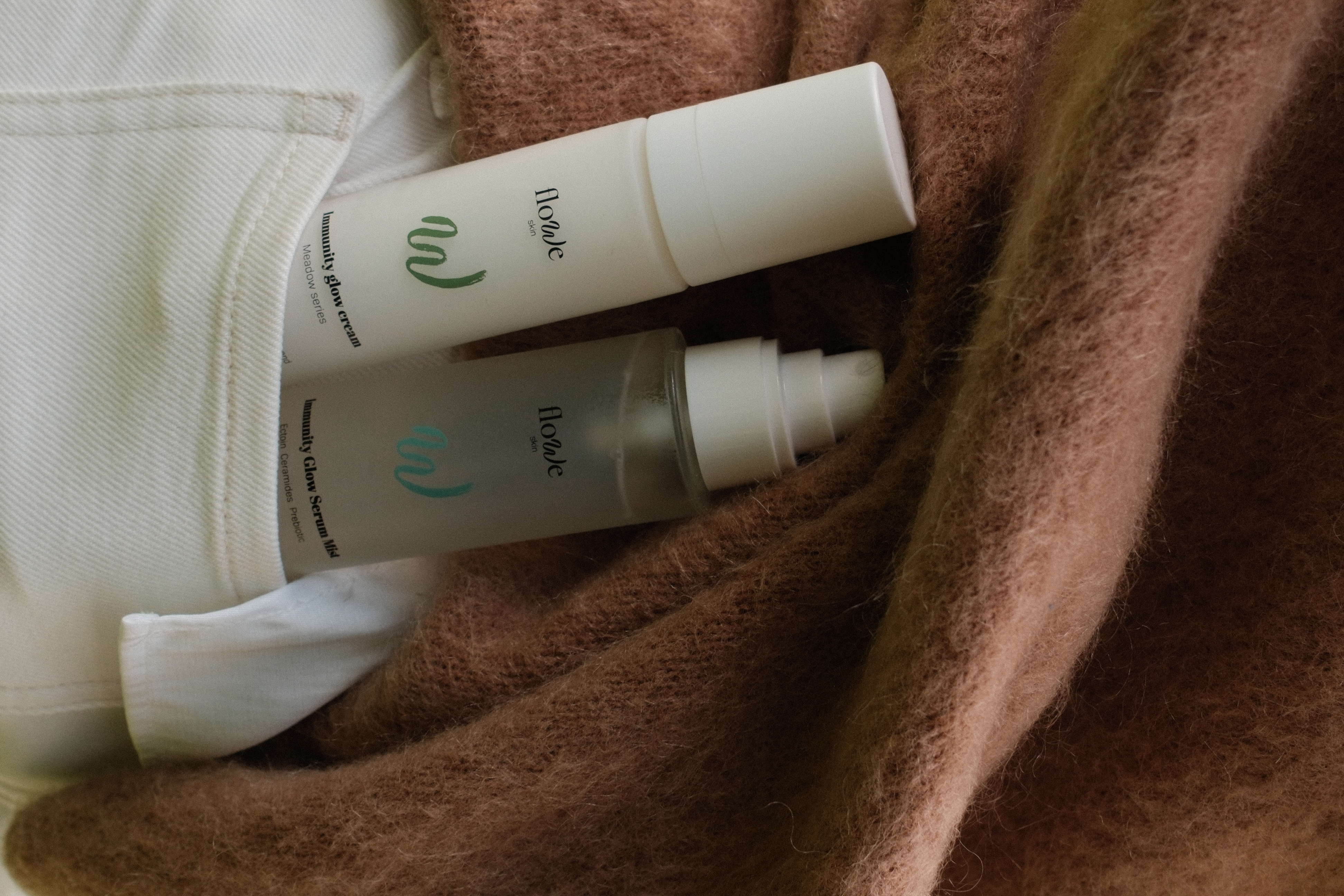
Immunity Glow Serum Mist (100 ml) and Immunity Glow Cream (50 ml) are built around that same idea, in two textures. Reading through the INCI lists, as the team behind one of the actives inside them, but also just as formulation-minded scientists, a few things stood out.
The barrier-and-hydration backbone. The mist pairs ceramides NP and NG, the same lipids skin uses to build its own barrier, with hyaluronic acid, glycerin, sorbitol and inulin. That's not a random humectant cocktail; ceramides plus hyaluronic acid is close to a biomimetic approach, replenishing what the barrier is actually made of rather than just trapping water on the surface. The cream adds shea butter and grape seed oil for the lipid layer, which fits a richer, more occlusive texture.
The microbiome angle. Both products lean on inulin (a prebiotic fibre that feeds beneficial skin bacteria) and, in the cream, lactobacillus and bifidobacterium ferments. Worth being precise here: these are typically ferment filtrates or lysates, not live bacteria surviving in a jar, but that's still meaningful, since it's the metabolites these bacteria produce (postbiotics) that tend to do the signalling work for barrier and microbiome balance, not the live cells themselves.
The botanical layer. Red clover (Trifolium pratense) brings isoflavones associated with skin firmness; lady's mantle (Alchemilla vulgaris) is a traditional astringent and soothing extract; cornflower water (Centaurea cyanus) is a classic calming ingredient, often used for sensitive skin. Together with DragonCell, they build a consistent “calm and protect” story rather than a scattershot list of trending actives, exactly the kind of formulation philosophy we like to see our ingredients sitting inside.
“My own favourite of the two is the mist. It’s such a light pleasure- the perfect addition to a day, something I toss in my bag on my way out the door, in between meetings and running through everyday tasks. In those moments when I need a second to just breathe, it’s become a small ritual: not only reaching for water to hydrate from the inside, but a spritz of the mist to hydrate my skin at the same time.”
Aiga Mazurenko, Sales Project Director, Alternative Plants
DragonCell™, in Plain Language
This is the ingredient we're proudest of seeing here, because its story is worth telling properly.
What it is. DragonCell is an extract made from the stem cells of Northern dragonhead, a small blue-flowered plant found in a handful of places across Northern Europe, including Latvia. The INCI name- Dracocephalum ruyschiana callus extract, tells you exactly what it is: callus cells, meaning undifferentiated plant cells grown in culture.
How we obtain it, and why that matters. Here's the part that isn't obvious from a product label: Northern dragonhead is rare. Its wild populations are fragmented and shrinking, it's listed in the Baltic Sea region's Red Data Book, and it's strictly protected under the Bern Convention on the Conservation of European Wildlife and Natural Habitats. There is no ethical way to build a skincare ingredient by harvesting it from the wild at any real scale, so we don't.
Instead of picking the plant, we grow its cells. A small piece of plant tissue is induced, in controlled lab conditions, to form a mass of undifferentiated “callus” cells, and those cells are coaxed to produce the same protective compounds the plant would make in nature, without a single wild dragonhead ever being disturbed.
That's plant cell biotechnology in one sentence: we keep the compound, and leave the plant exactly where it belongs.
“DragonCell fits excellently in the Flowe Skin concept – it is not aimed at changing skin, with it’s moisturising, antiinflammatory, antioxidanta activities it supports skin health and protects from environmental stressors maintaining skin balance and longevity”
Anna Ramata-Stunda, Sales Project Director, Alternative Plants
What's valuable in it. DragonCell is rich in phenolic compounds- over 60% of its phenolic content is made up of caffeic acid derivatives, including rosmarinic acid, chlorogenic acid, salvianolic acid B, and caffeic acid itself. These are well-characterised antioxidant and anti-inflammatory molecules, the same broad family of compounds found in rosemary and sage, but here concentrated through cell culture rather than diluted the way they'd be in a whole-plant extract.
What the research shows.
In laboratory (in vitro) testing on skin cells:
• Skin keratinocytes pre-treated with 1% DragonCell showed 27% higher viability after UVA/UVB exposure compared to untreated cells.
• The same UV-exposed keratinocytes showed a 36% reduction in reactive oxygen species (ROS) at 0.5% DragonCell.
• In dermal fibroblasts, DragonCell reduced expression of MMP- the enzyme responsible for breaking down collagen- by 63.4% at 0.5% and 74% at 1%.
• At 0.5–1%, it modulated endothelial cell behaviour (capillary branching and tubule length), the mechanism behind its relevance for reactive, redness-prone skin.
In a real-world (in vivo) study- the one behind the actual FLOWE Skin formula- a cream with 2% DragonCell was tested against an identical placebo cream in a split-face design on 42 participants, measured with a Corneometer over 8 weeks, conducted in Latvia through the high-UV, high-heat summer months. The DragonCell side showed a statistically significant increase in hydration compared to both its own baseline and the placebo side, and that improvement held up over the full 8 weeks, not just an initial spike.
What it means for skin. DragonCell gives skin an extra antioxidant and collagen-protecting buffer against the everyday stress, sun, heat, pollution, that quietly accelerates ageing and reactivity. And because it comes from cultured cells rather than wild harvest, none of that protection costs the plant anything.